BBB: A New Human–AI Collaborative Interpreting Service
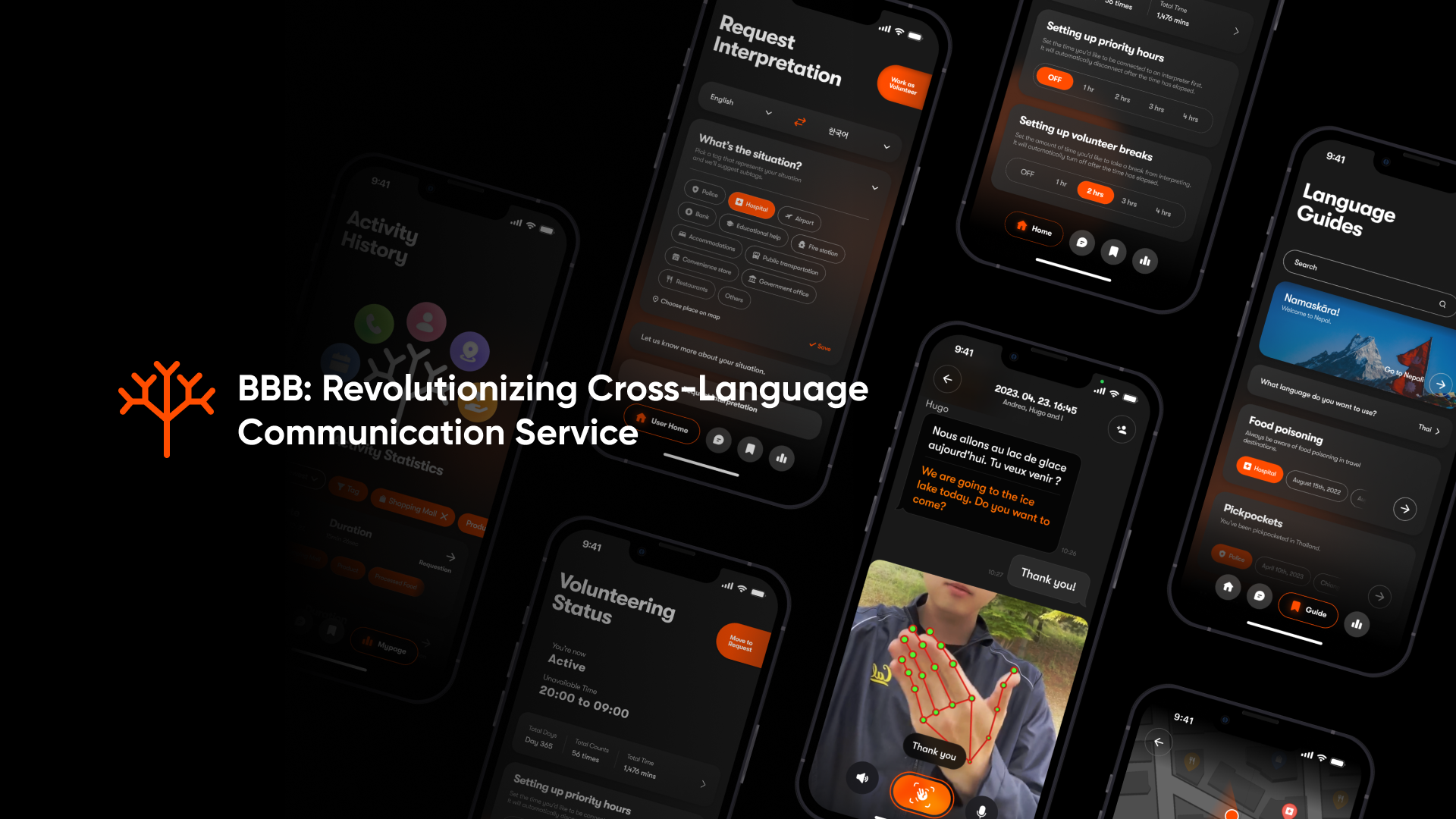
1 Overview
- After redesigning BBB Korea’s user and volunteer apps, we explored how the service could evolve as AI translation becomes common. We proposed a hybrid model. AI handles simple, repetitive translation quickly, while human interpreters step in when cultural context or trust matters.
- The final concept has four parts: sharing the context of an interpretation request, supporting multi-party conversations and sign language interpretation, offering Language Guides based on usage history, and making help and contributions visible. The project received a 2023 Red Dot Award in the Apps category of Brands & Communication Design.
- Role: I contributed throughout the team’s ideation process. I proposed a way for users to thank volunteers, as well as concepts for multi-party and sign language interpretation. The multi-party concept assumed that personal audio devices would become widely used. I later designed the interfaces for both features.
2 Context
BBB Korea connects people who need language help with volunteer interpreters over the phone. This project followed our redesign of its user and volunteer apps. The earlier work focused on the information architecture and usability of the current service. This time, we looked at the role a human-centered interpretation service could play as machine translation and conversational AI become common.
We started with a simple question: “If AI can handle basic translation, when can human interpreters provide the most value?” We also asked whether a one-off call in an urgent situation could lead to language learning, cultural exchange, or volunteering later on.
We reviewed user feedback on the existing service and relevant literature, then focused on four problems:
- Interpreters may not know a user’s location, purpose, or level of urgency until the call begins. As a result, users may need to explain the situation again at the start of the conversation.
- Literal translation can miss slang, idioms, accents, and local cultural norms.
- One-to-one phone interpretation cannot easily support conversations involving several languages or people who use sign language.
- Useful expressions and cultural knowledge are not saved for later. A volunteer’s contribution can also become hard to see once the call ends.
We therefore designed a communication service that matches each situation with the right mix of AI and human support. It supports different ways of communicating and turns each session into a resource that users can return to later.
3 Approach
3-1 Defining the roles of AI and people
AI handles tasks where speed and scale matter: instant translation, conversation records, distinguishing speakers, and suggesting common phrases. People step in for cultural nuance, ambiguous language, emotional support, or situations that demand high accuracy. This division guided when the service would rely on AI and when it would connect users with a volunteer interpreter.
The support changes with the urgency and complexity of each request. AI can help with simple conversations right away. Urgent situations or those that call for careful judgment go to volunteer interpreters. When AI cannot fully explain a cultural expression, a person adds context. We placed AI at the first stage of support, not as the final decision-maker.
3-2 Moving from conversational to cultural interpretation
We created hypothetical personas and scenarios for people living abroad and international students. One scenario featured a student who could not follow Australian slang but pretended to understand because interrupting the conversation felt awkward. Another involved an international student who could not make sense of a conflict shaped by Korean bus culture through literal translation alone.
The scenarios showed that even an accurate translation may not be enough to help someone take part in a conversation naturally. We shifted the project from interpreting conversations to interpreting culture. Users could select a line from the conversation, ask AI for context, or get an explanation from a person.
We also considered a separate cultural exchange community where users and volunteers could ask and answer questions. It did not become a main feature. Instead, we carried its focus on continued learning and connection into Language Guides based on usage history and Activity History.
3-3 Multi-party interpretation with personal audio devices
Assuming that devices like AirPods would become common, we designed an interpretation experience for several people. People speaking different languages in the same space hear translations through their own devices. The screen separates the conversation by speaker.
The interface shows participants, detected languages, and speaker-by-speaker conversation history in one place. Users can replay a line, check the translation, or ask AI or a person for clarification. We considered remote use, but the initial prototype focuses on in-person conversations.
3-4 Including sign language in the interpretation flow
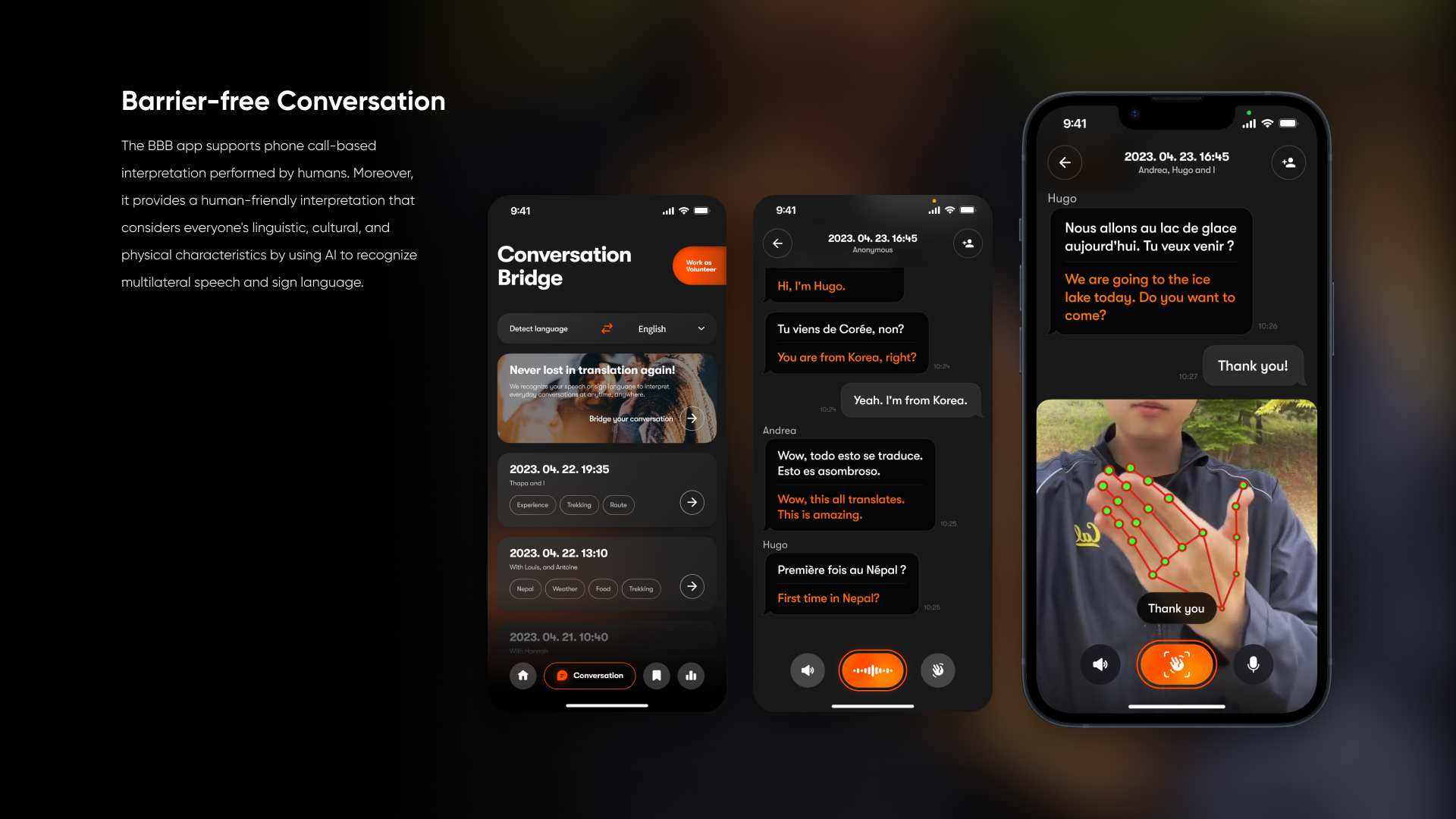
Phone and voice-based interpretation cannot fully support sign language users or conversations that rely on non-spoken communication. We designed a flow in which the camera recognizes signing and converts it into sentences. The other person’s speech appears as text.
The interface shows the camera feed, recognition status, converted sentence, and conversation history at once. We did not connect a working sign language recognition model. The competition video simulates a future experience, so the prototype does not validate technical performance or accessibility. It shows what an inclusive interpretation service might look like.
3-5 Connecting the experience before and after a session
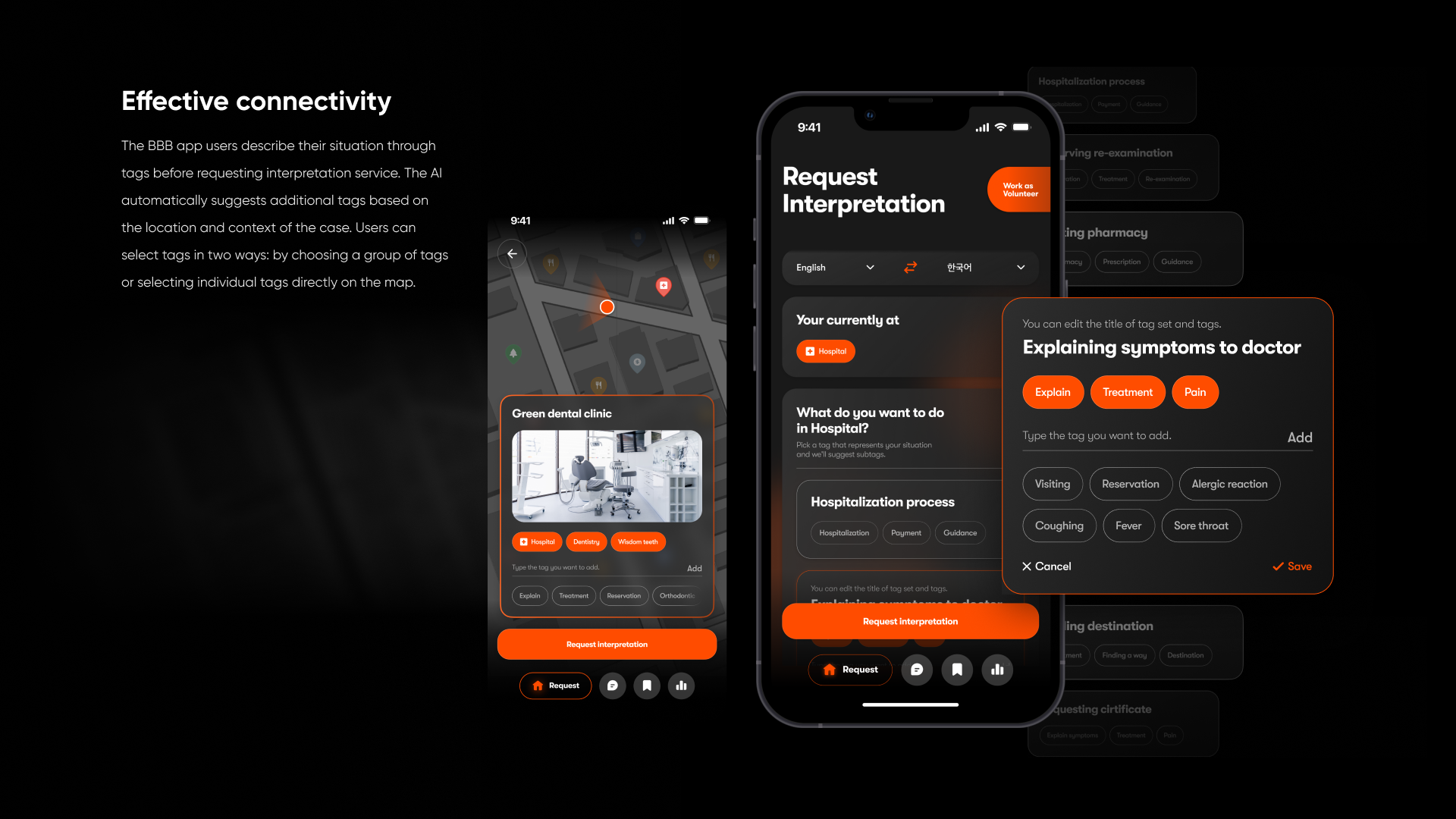
Before a session, users describe their location and situation with tags. AI suggests more tags based on the current context. This gives the interpreter basic information before joining and reduces repeated explanations.
After the session, Language Guides recommend useful expressions and cultural notes based on the user’s location and past use. Activity History records the number, duration, and location of sessions, along with the help exchanged between volunteers and users. Users can thank volunteers, and volunteers can see the effect of their work. Together, these features connect a one-off interpretation session to continued learning and participation.
3-6 Narrowing and visualizing the core experience
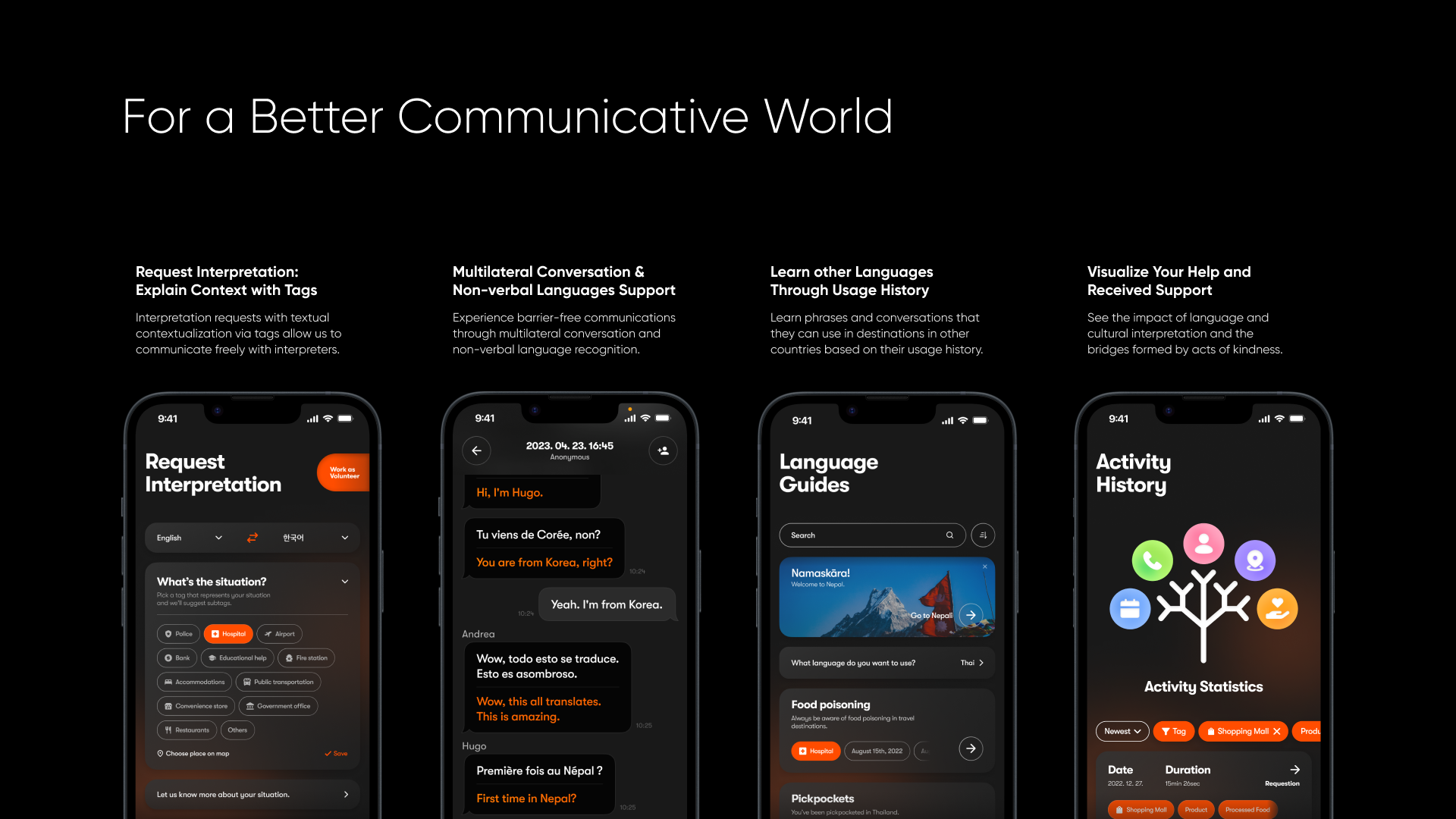
We narrowed the ideas to four core experiences. Request Interpretation shares the context of a request in advance. Conversation Bridge supports multi-party conversations and sign language interpretation. Language Guides turn past sessions into material for future situations. Activity History makes the meaning and impact of help visible.
Starting in mid-April, we refined the speech recognition, participant identification, sign language recognition, and conversation history screens. We tried several visual directions, including a light theme. We settled on black and orange, then completed the final screens and prototype for the competition.
4 Outcome
4-1 Four core service experiences
Request Interpretation: Sharing context before the call
Before asking for an interpreter, users describe their location and purpose with tags. AI suggests more tags based on the location and context, so the interpreter can understand the situation before joining.
Conversation Bridge: Connecting languages and ways of communicating
The service distinguishes speakers and languages, translates into each person’s language, and organizes the conversation history by speaker. We also designed a camera-based sign language interface to show how sign language users might take part in the same conversation.
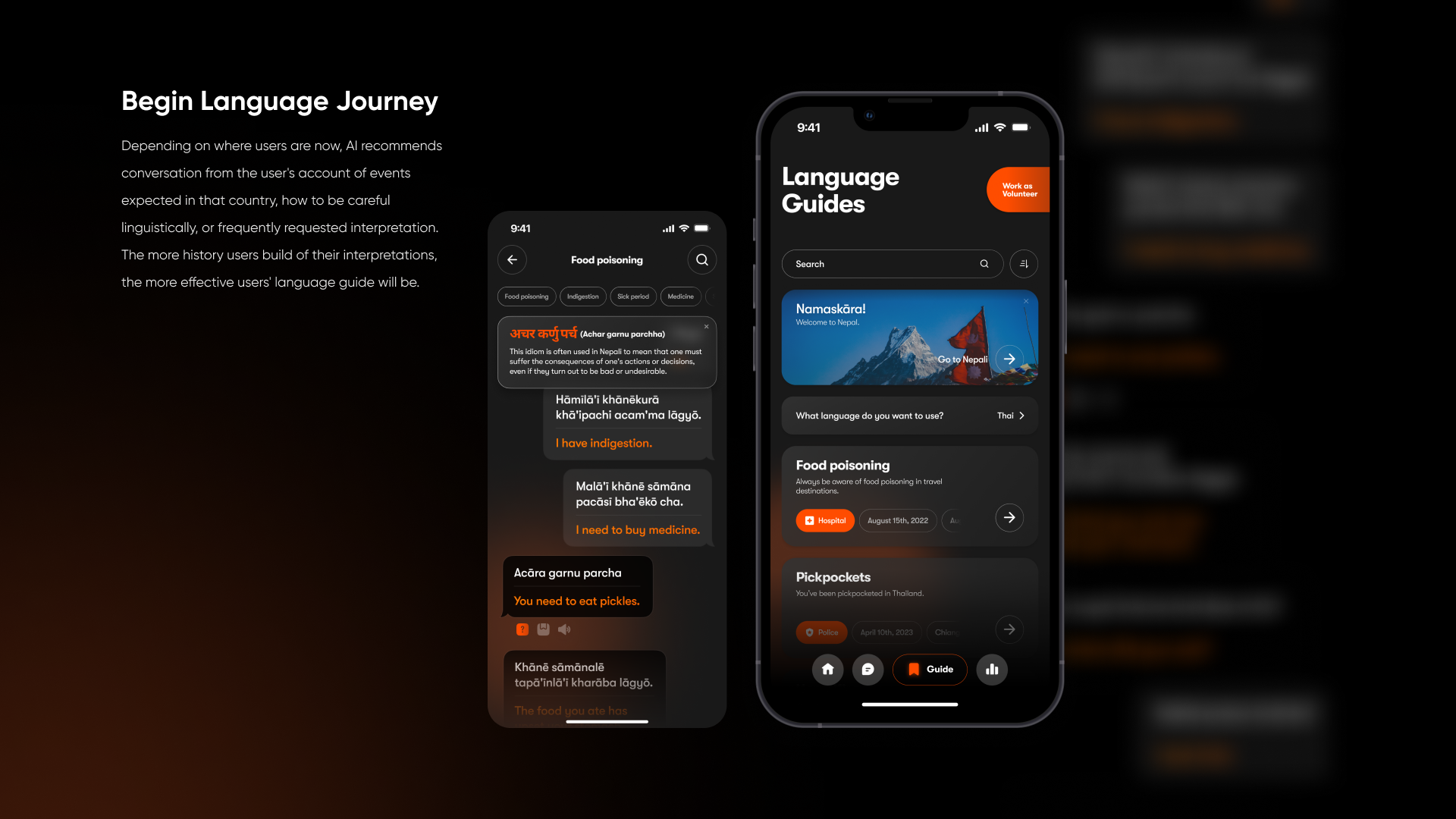
Language Guides: Reusing what people learn during interpretation
Based on past sessions and the user’s current location, the service suggests useful expressions, phrases related to earlier conversations, and cultural notes. Users can return to what they learned when they face a similar situation later.
Activity History: Making the impact of help visible
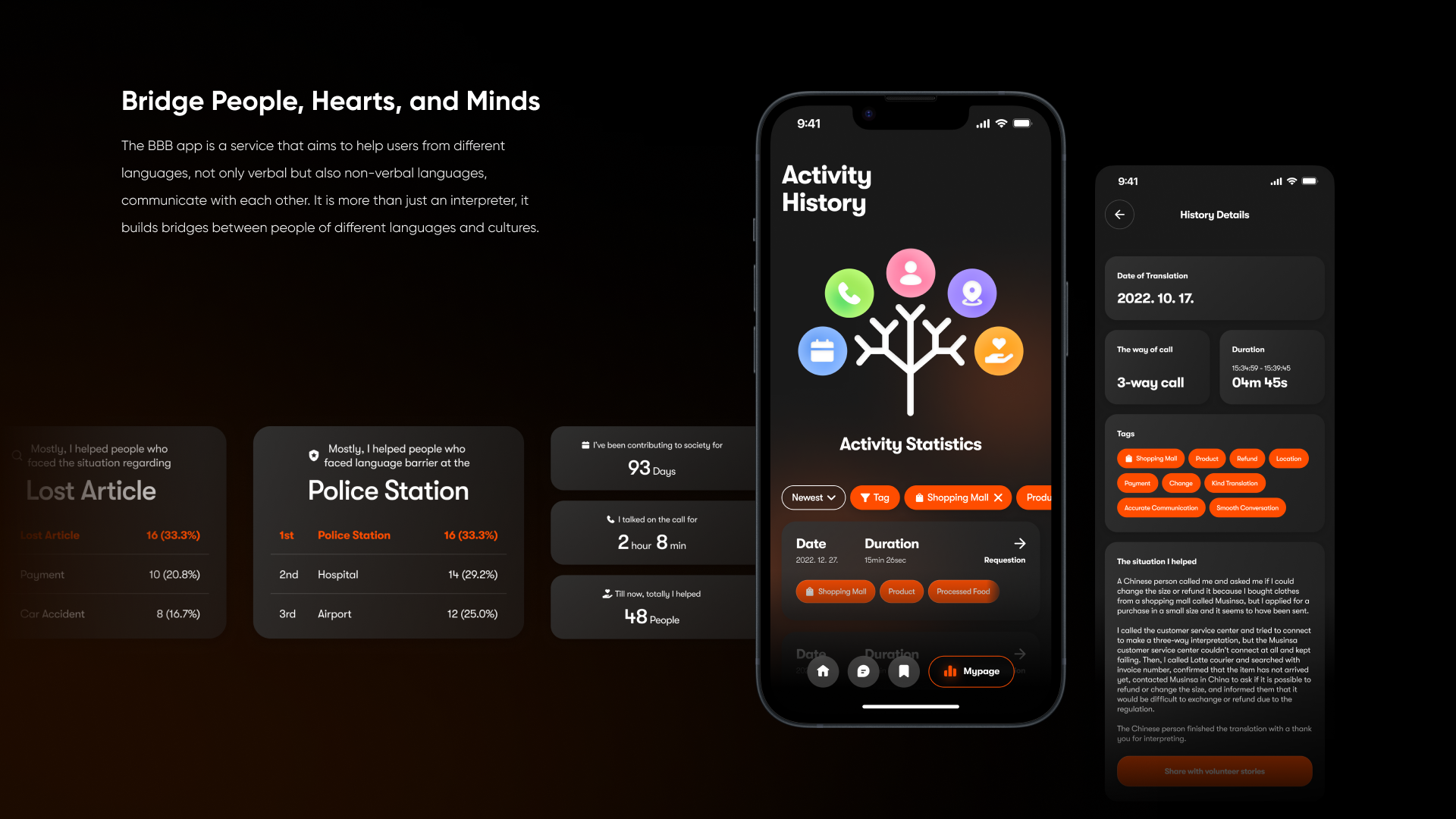
Activity History shows the number, duration, and location of interpretation sessions, along with the help people gave and received. Volunteers can see who they have helped, and users can thank the person who interpreted for them.
4-2 Red Dot Award
The project received a 2023 Red Dot Award in the Apps category of Brands & Communication Design.
5 Reflection
We assigned fast, repetitive translation tasks to AI and brought people in when cultural context or trust mattered. We wanted to explore new technology without losing the value of human interpretation. I came away from the project convinced that more automation does not necessarily make a service better. The harder design problem is deciding what AI should handle, when a person should step in, and how that boundary should shift with the situation.