EVNIIN: Designing Evenings That Support Sleep
1 Overview
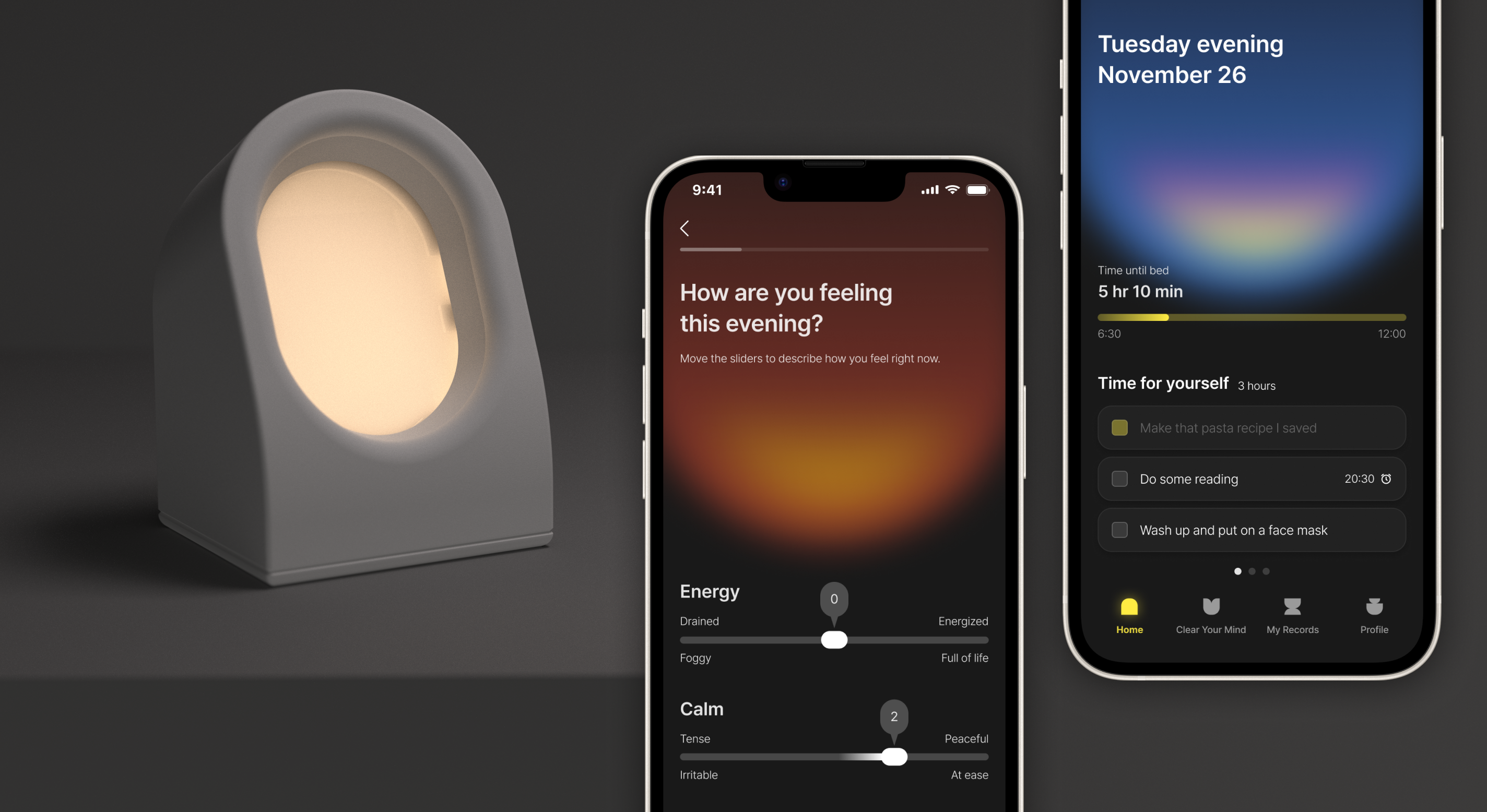
- EVNIIN is my undergraduate graduation project exploring mental well-being among people in their twenties through sleep and their evening experience. User research led me to reframe the problem around difficulties managing emotions and stimulation before bed. I designed and prototyped EVNIIN, a product-service system combining an app and smart lighting to help people shape their evenings and prepare for healthy sleep.
- Role: Solo project (user research, service planning, UI/UX design, Arduino and Flutter prototyping)
2 Context
Everyday mental well-being for people in their twenties
The project began with a design brief from its sponsor, HUROM: to develop a mental healthcare tool or service that could help ease anxiety and depression.
Between 2017 and 2021, the number of people in their twenties receiving treatment for depression in South Korea rose by 127.1%, while the number receiving treatment for anxiety disorders rose by 86.8%. 1 Against this backdrop, and considering HUROM’s need to reach a new customer group, I explored ways to support mental well-being that young adults could naturally incorporate into everyday life.
3 Approach
3-1 Desk Research & Competitive Analysis
People in their twenties, particularly Gen Z, are interested in improving their quality of life and open to caring for their mental well-being.
Online research reports suggested three tendencies: they (1) see mental health as part of self-care, (2) value healthy, productive routines, and (3) seek sensory pleasure and immersive experiences to escape everyday stress.
I saw an opportunity in connected products and services that make everyday self-care easier.
I gathered 57 existing mental healthcare products and services and mapped them by whom they serve (WHO), what they address (WHAT), and how they intervene (HOW).
- WHO: Solutions for people who need support with self-care
- WHAT: Solutions addressing specific mental health conditions
- HOW: Solutions involving a physical product or an intervention
 Competitor analysis Venn diagram.
Solutions offering specialized technologies or clinical treatment fell outside the scope of this project. Instead, I found an opening for connected products and services that help people put familiar self-care practices into their daily lives.
With my target users in mind, I chose to explore indirect support for shaping healthier everyday routines, rather than providing treatment.
3-2 Exploratory Research & Problem Definition
I interviewed experts and young adults to better understand the mental health difficulties people face in daily life and how they care for themselves.
Expert Interviews
I spoke with a full-time counselor and a physician at the UNIST campus healthcare center.
Key findings
Problem spaceMajor concerns among young adults included anxiety, depression, and insomnia, often linked to career uncertainty and interpersonal conflict.Problem spacePeople often experience sleep difficulties before other mental health problems.Solution spaceAlongside medication, counseling or coaching and basic self-care, including regular sleep and exercise, are important.
User Study
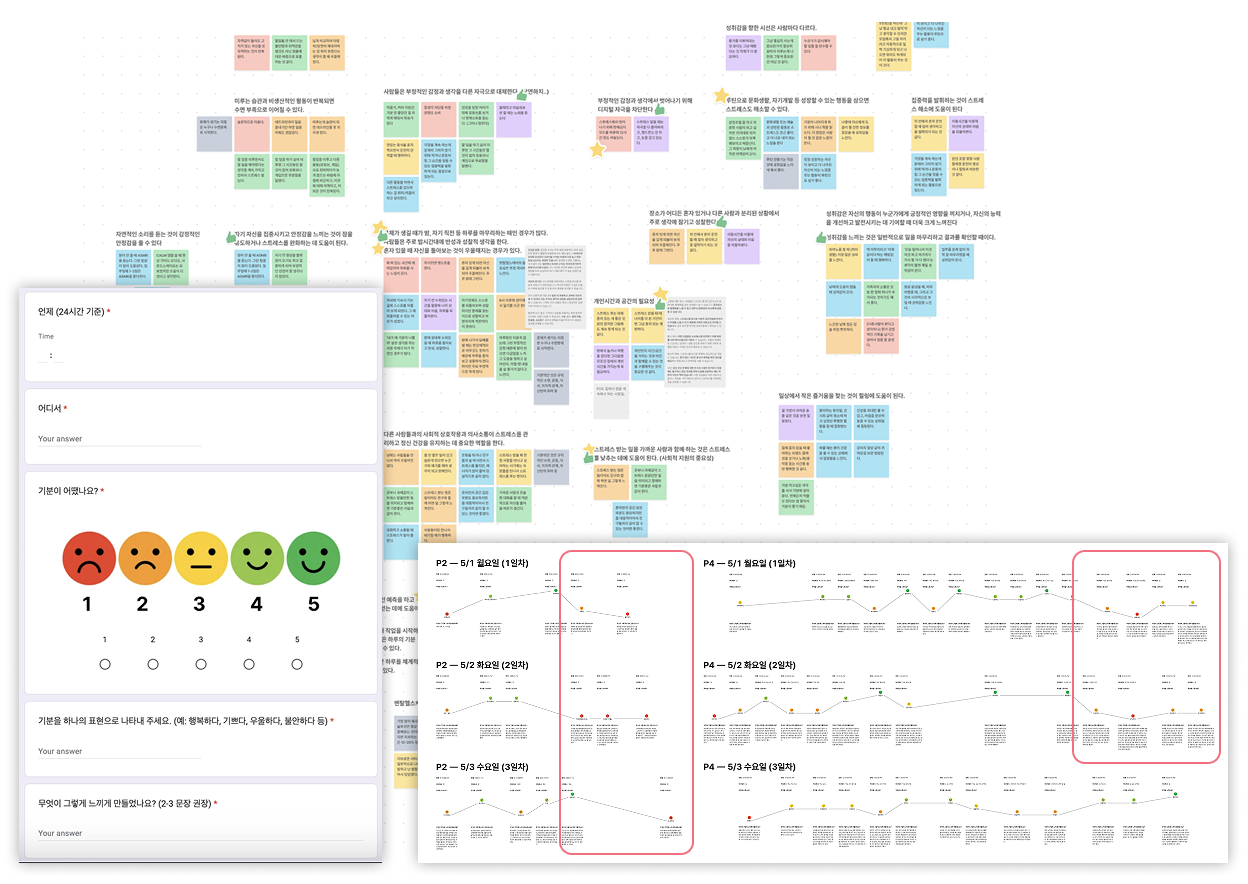
I worked with six people aged 21 to 28 who were interested in mental healthcare products and services. They logged their emotions in real time for three days, followed by semi-structured interviews. I analyzed the findings using affinity mapping.
Key findings
Problem spaceNegative emotions and ruminative thoughts tended to surface at night, especially before bed.Solution spaceMaking time for oneself and keeping healthy routines could help reduce stress and support happiness.
Initial Problem Definition
The experts’ emphasis on sleep and the emotional difficulties participants described before bedtime pointed me toward a cycle linking negative emotions in the evening with sleep problems.
Daily stress can contribute to depression or insomnia. Negative feelings and thoughts may grow stronger toward the end of the day, disrupting sleep. Poor sleep can then affect daytime functioning and add more stress, reinforcing the cycle.
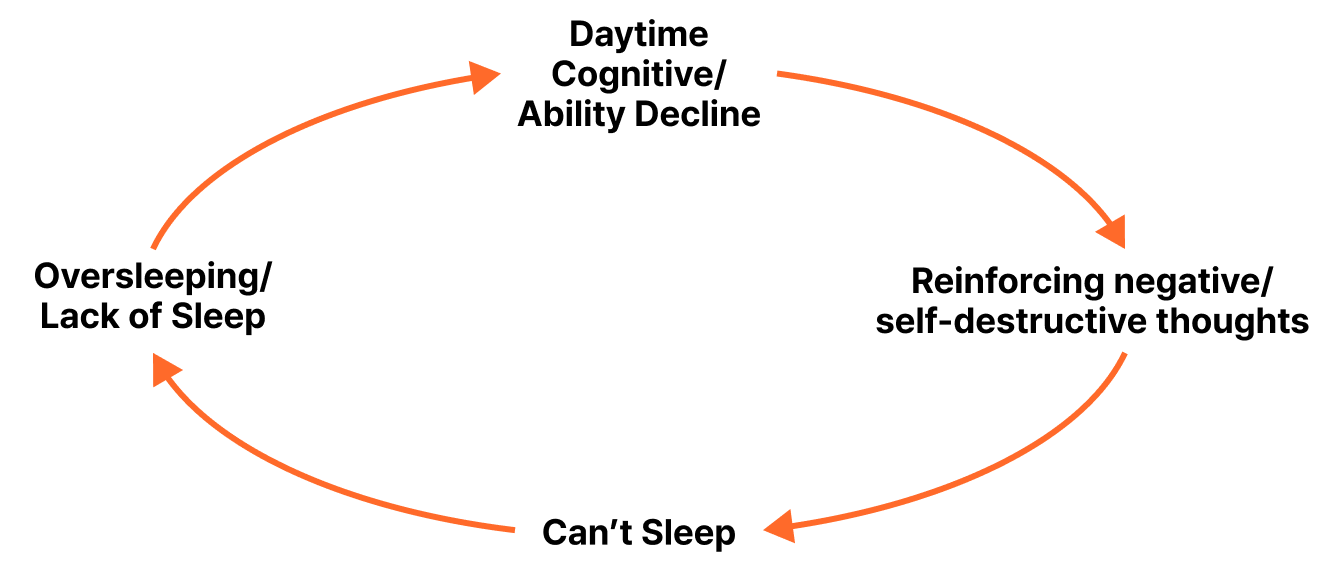 The vicious cycle between sleep problems and negative emotions.
Even when people know that routines and time for themselves matter, it can be difficult to spend the evening, a time that should offer recovery, in a healthy way.
This led to my initial design problem:
The hours before bed should be a time to recover and prepare for sleep. Yet for many people in their twenties, negative emotions and rumination intensify during these hours, contributing to a cycle of sleep and mental health difficulties.
3-3 Exploring the Solution Space
Is helping someone fall asleep enough?
I looked at sleep-inducing lights, sleep robots, sleep-tracking services, and other existing solutions. Many focused on improving the sleep environment or helping people fall asleep sooner.
Healthy sleep also depends on sleep hygiene, including regular bedtimes and managing stimulation before sleep.
But knowing what makes for good sleep does not necessarily mean being able to put it into practice. I began to consider whether the difficulty starts well before someone gets into bed.
That raised a new question: Why do people put off bedtime even when they know they should sleep?
3-4 Further Research & Reframing the Problem
Bedtime Procrastination
Bedtime procrastination means going to bed later than intended despite having no external reason to delay. It has been associated with higher levels of depression and anxiety and lower sleep quality. 2
In a study of 60 people in their twenties, a team led by Professor Suyeon Seo at Sungshin Women’s University reported two leading psychological reasons for delaying bedtime: escaping negative thoughts or unpleasant feelings (31.3%) and rewarding oneself after a hard day (26.5%). 3
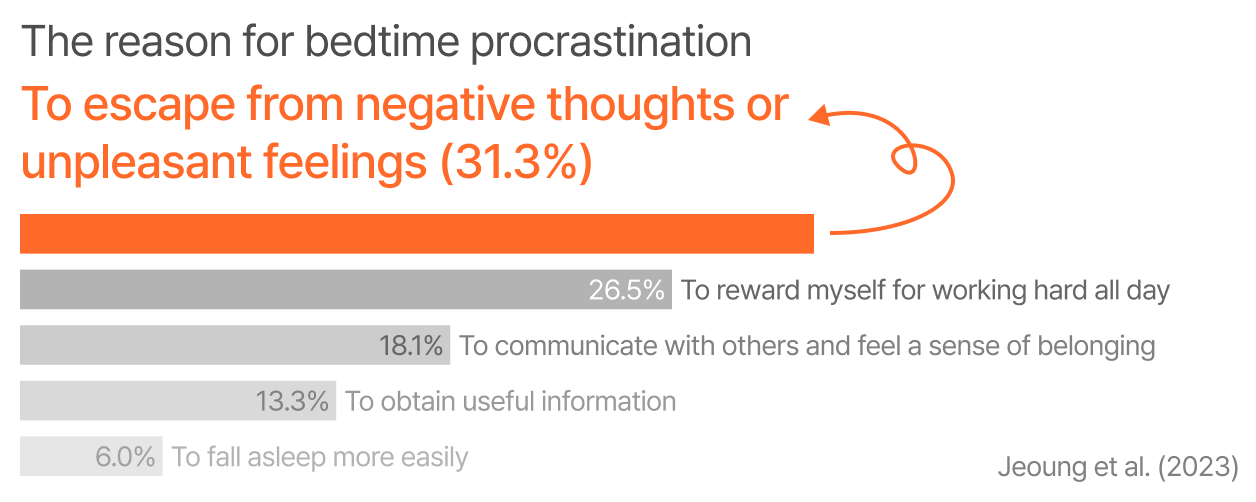 Reasons for bedtime procrastination among people in their twenties.
This suggested that unmet emotional needs during the day might contribute to bedtime procrastination.
User Study
I surveyed five people in their twenties who felt they delayed their own bedtime using the Bedtime Procrastination Scale (BPS) 4 and followed up with in-depth interviews.
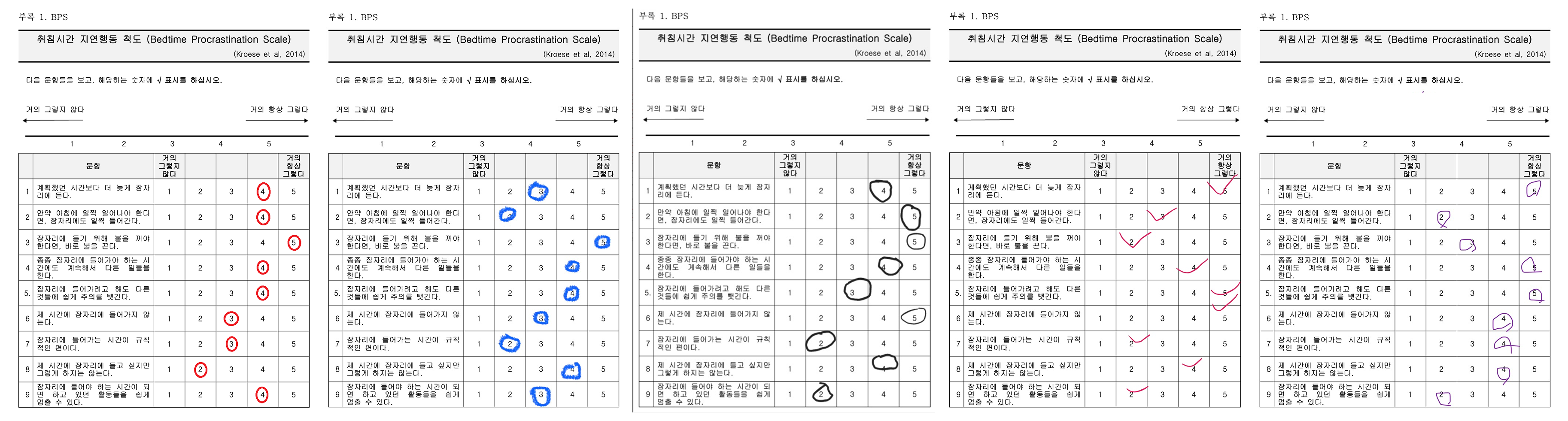
Key findings
Problem spaceParticipants with a stronger tendency to procrastinate at bedtime (BPS scores of 31 or above) were easily drawn to quick, accessible digital stimulation, such as Instagram Reels and YouTube Shorts, when they had not sufficiently relieved their stress.Problem spaceThis pushed bedtime later, leaving them without enough stress relief and often worsening negative emotions.- Previous research likewise suggests that when negative feelings are not adequately managed, people may try to regulate their emotions through bedtime procrastination, with adverse consequences for sleep. 5
Solution spaceChanges to the physical environment or timely outside intervention were important in interrupting negative thought patterns and shifting away from bedtime procrastination.
How Sleep and Emotion Affect Each Other
Further reading showed that sleep and mood can reinforce or undermine each other. Too little sleep increases irritability, frustration, and mood swings, and can heighten sensitivity to stressful situations. 67 Conversely, emotional distress, worry, and rumination while awake can reduce the quality of later sleep and make it more fragmented. 89
Negative feelings and heightened arousal before bed can interfere with falling asleep. Not getting enough rest can then unsettle mood and everyday functioning the next day. 10 Evening emotions and sleep are not separate problems. When one suffers, the other may follow.
Rather than focusing only on getting people to sleep earlier, I decided the design needed to help them manage their emotions and exposure to stimulation throughout the evening.
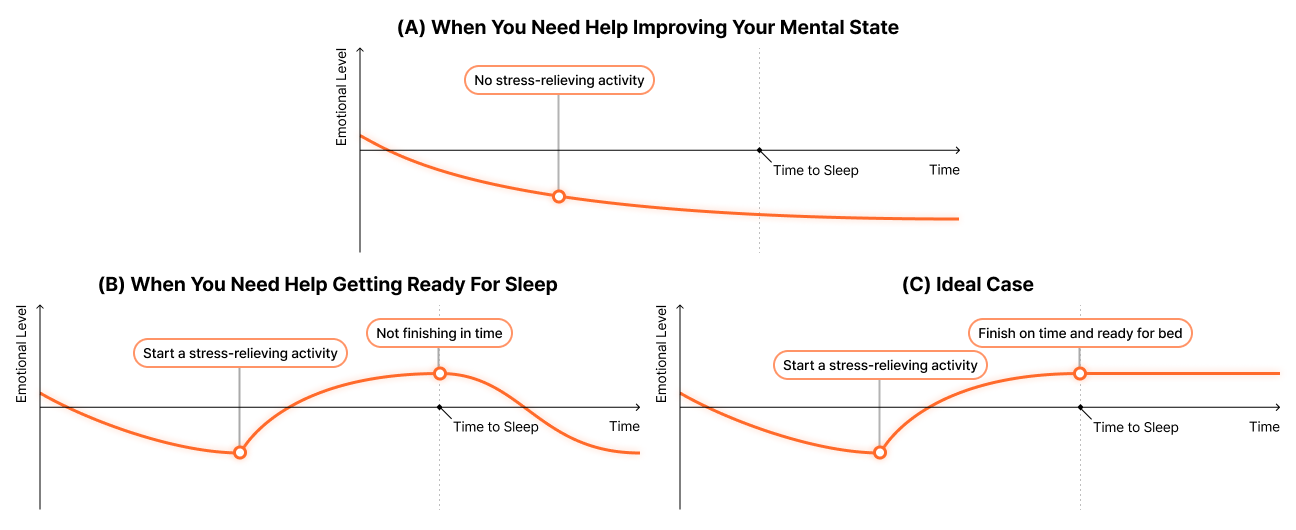
Reframing the Problem
Putting these findings together, I reframed the problem around the reasons behind the behavior:
People in their twenties who procrastinate at bedtime often struggle to regulate their emotions and stimulation during the evening. This makes it difficult to follow a regular sleep routine and can perpetuate a cycle of sleep and mental health difficulties.
3-5 Developing the Design Concept
Design Direction
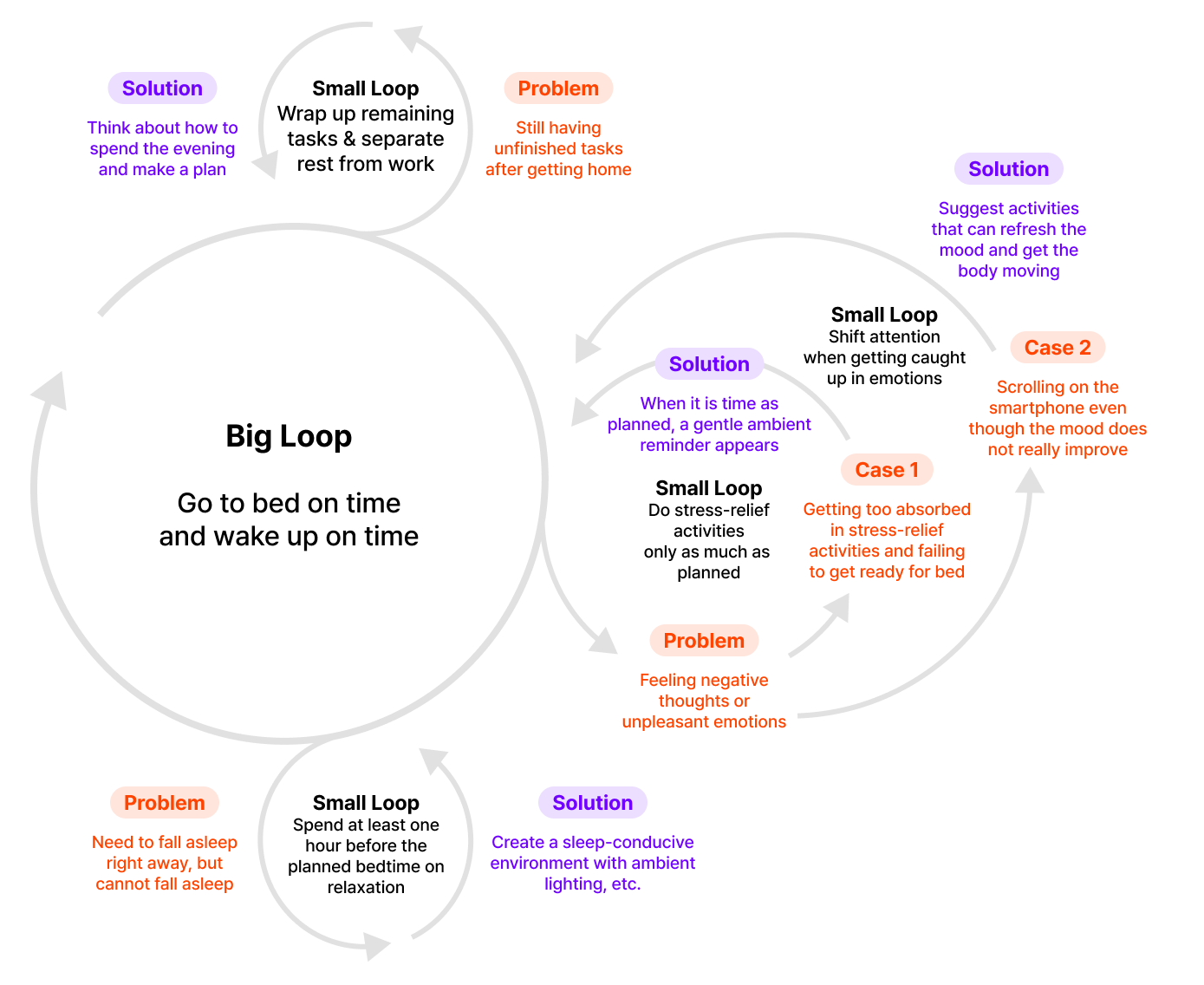
Making the most of the evening to get to bed on time
I came to see that improving sleep meant looking beyond the moments just before bed and considering the entire evening.
I set three goals to help people notice when they had drifted from their planned routine and find their way back to restorative activities.
Three goals
Support self-awareness: Help users notice and ease negative feelings during the evening.
Encourage a shift toward restorative activities: Offer external cues that help users move away from quick digital stimulation.
Make room for sleep preparation: Protect a buffer period before bed for unwinding and getting ready to sleep.
Designing Cues for Behavior Change
Offering a chance to shift, rather than forcing a behavior
Even when people know a healthy evening routine matters, fatigue and stress can make following through difficult.
I drew on Fogg’s Behavior Model, which describes motivation, ability, and triggers as the three elements involved in behavior. 11
- Motivation: The desire to perform a behavior
- Ability: How feasible it is to perform that behavior
- Trigger: An external cue that prompts action
An effective trigger depends on someone’s motivation and ability at the moment. The model distinguishes three types:
- Spark: A trigger with a motivational element when motivation is low
- Facilitator: A trigger that makes action easier when motivation is high but ability is low
- Signal: A reminder when both motivation and ability are high
Using this model alongside my research, I mapped moments when people might need help shifting their behavior during the evening.
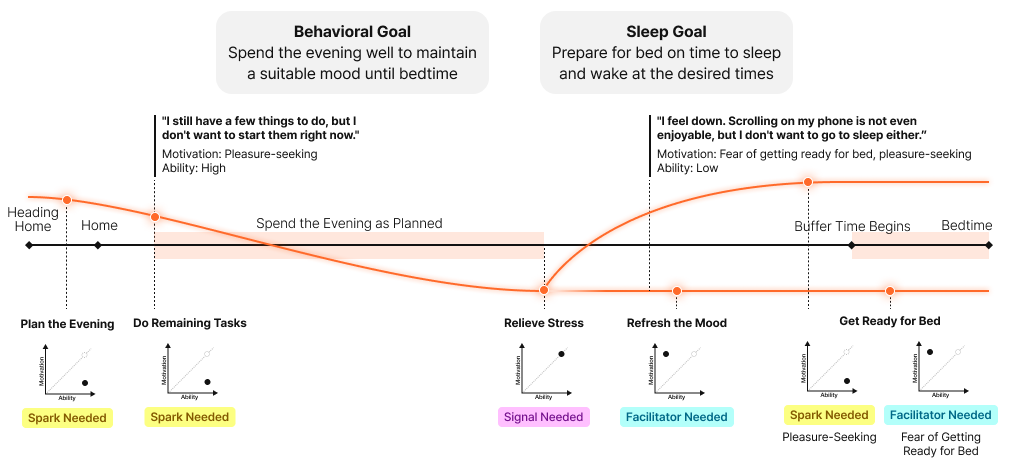 Triggers needed at each stage of the evening routine.
- Planning and following an evening plan: Ability is present, but motivation may be low, so motivational support is needed.
- Relieving stress: With both motivation and ability present, a reminder can be enough.
- Changing one’s mood: Motivation is high but ability is limited, so the next step needs to be made easier.
- Preparing for bed: During stress-relief activities, ability may be present but motivation low. When negative feelings take over, motivation may be high but ability low. These moments call for different kinds of support.
Refining the Concept
Shaping an evening that feels right, guided by self-awareness
At first, I considered strong external rewards to encourage people to follow through. But rewards can backfire, and prescribing the same behavior to people with different needs and circumstances could make them disengage.
Sleep problems are common in early adulthood. People in their twenties face growing social and academic demands alongside changes in habits such as device use and caffeine consumption. What matters is learning to adjust the evening to one’s own circumstances and routines.
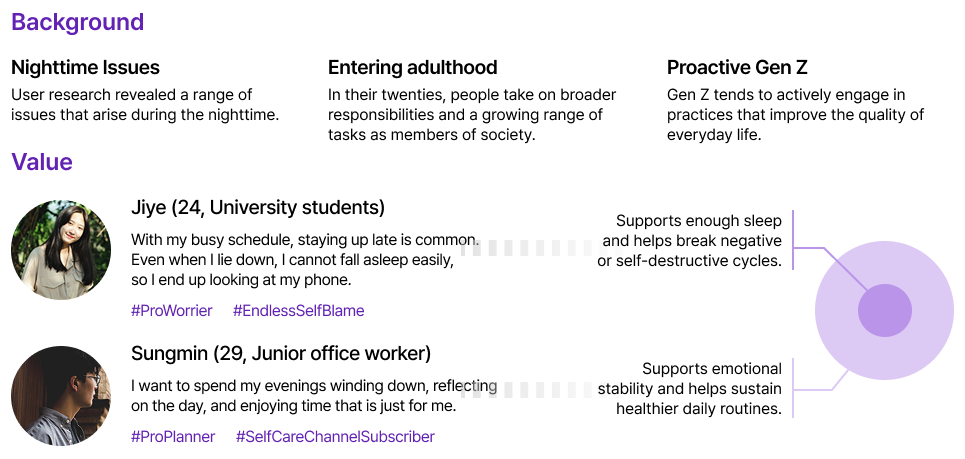
I felt that if people were to keep using this design, seeing themselves improve needed to be rewarding in itself. Rather than controlling what users do, I focused on helping them recognize their state and choose and adjust the activities they need that day.
I brought the concept together in four design principles:
- Help users recognize their emotions and level of arousal.
- Help users plan an evening that feels satisfying to them.
- Offer environmental cues that make it easier to switch activities.
- Help the body and mind transition into sleep just before bedtime.
4 Outcome
EVNIIN: A product-service system for the evening
EVNIIN combines a mobile app and smart lighting to help people in their twenties who struggle to regulate emotions and stimulation before bed.
It supports a connected experience of recognizing how they feel, planning a satisfying evening, and easing into sleep preparation.
The app offers a personal space for self-awareness and planning. The smart light uses changes in light and sound as environmental cues to help people shift activities and prepare for bed.
Four core experiences
Self-awareness: Helping users recognize their emotions and level of arousal as the evening begins.Time for fulfillment: Helping users plan their evening around the balance of rest and activity they need that day.Environmental cues: Encouraging transitions through gentle changes in light and sound rather than push notifications.Sleep hygiene: Helping body and mind wind down through buffer time, writing down worries, and guided breathing.
The four experiences are designed to flow together as one evening routine.
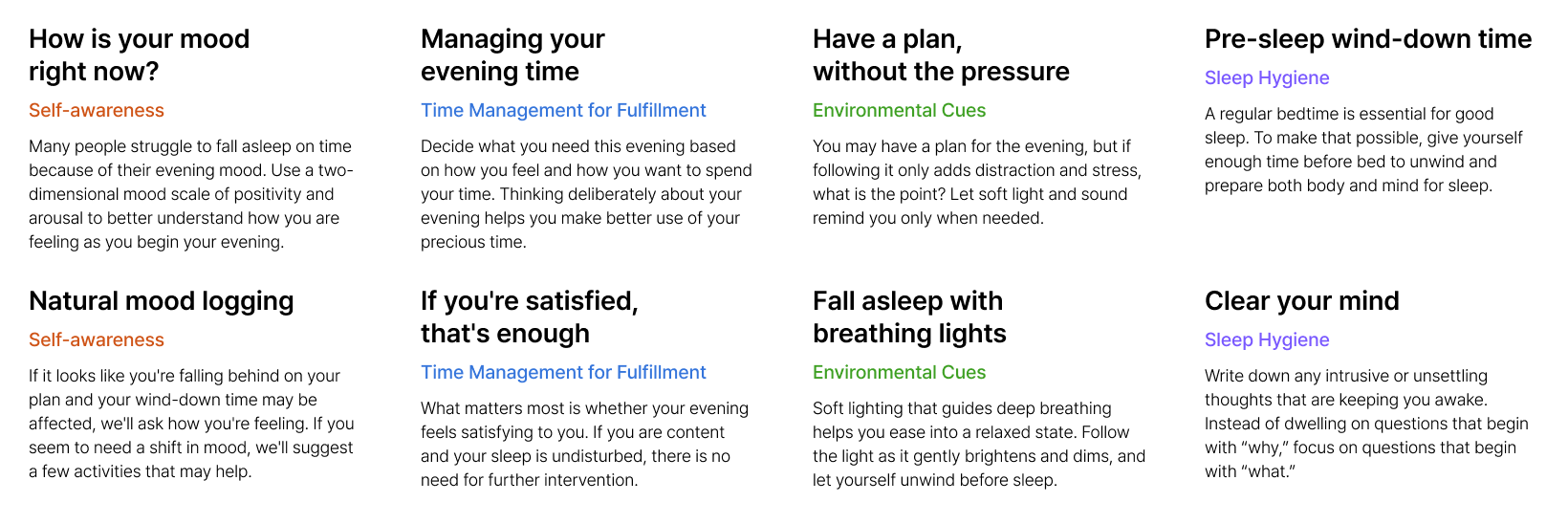 EVNIIN concept card.
4-1 An App for Planning Evenings Around Your Needs
The app brings together self-awareness, time for fulfillment, and sleep hygiene, giving users a way to check in with themselves and shape their own evenings.
-
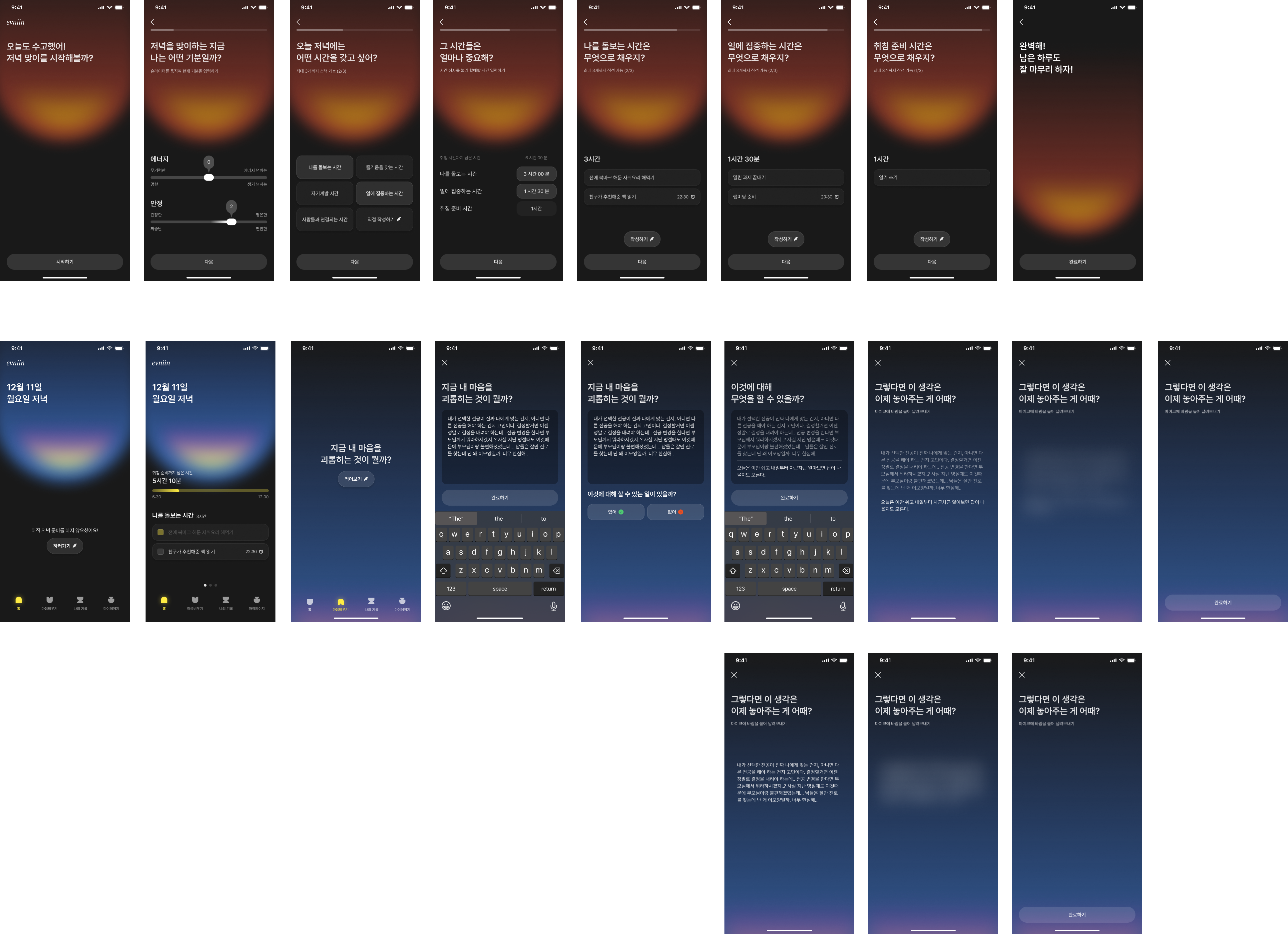
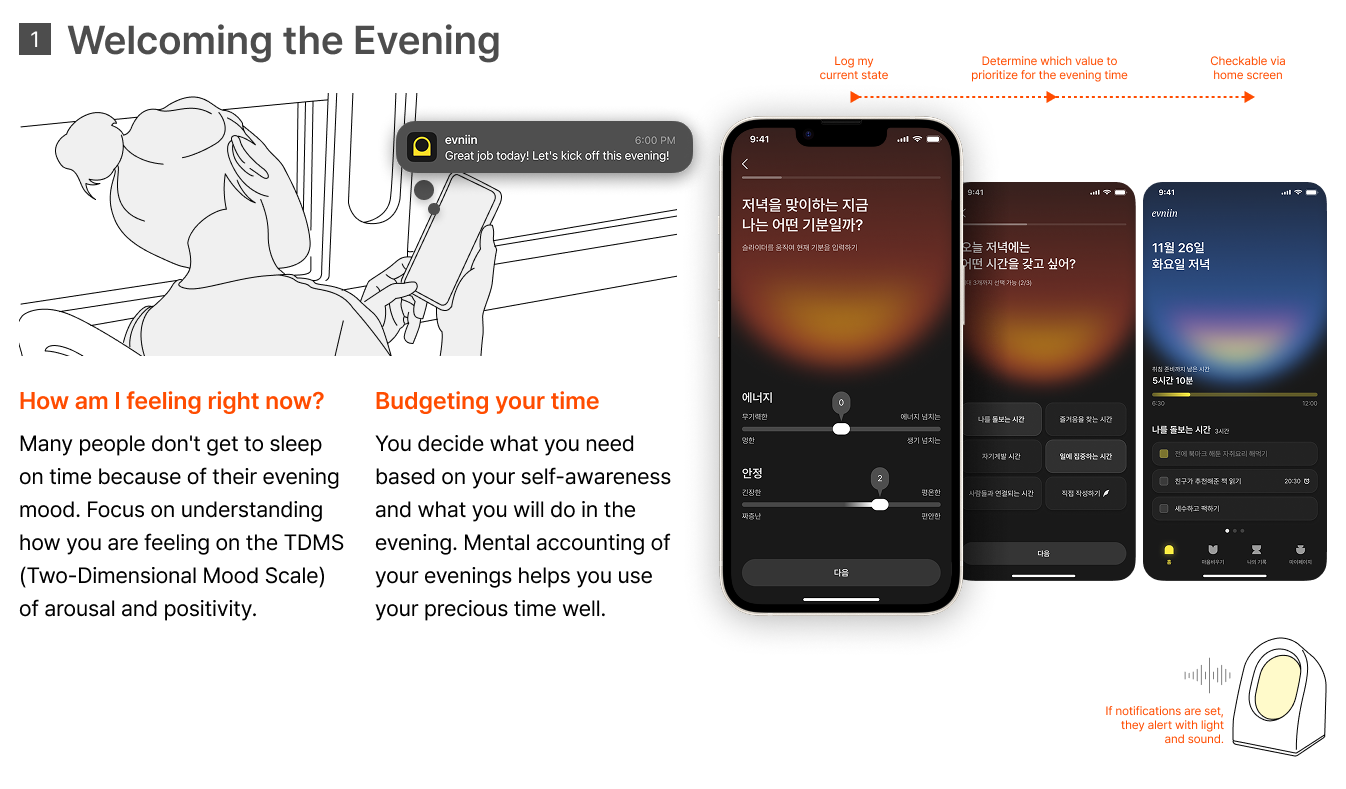
Starting the evening: Checking in
When the evening reminder arrives, users record their mood and level of arousal using an emotion slider and a two-dimensional mood scale. This helps them notice fatigue or stress they might otherwise overlook and recognize how they are beginning the evening.
-
Planning the evening: Making time for what I need
Users consider their current state and what they need, balance rest with activity, and plan the evening’s activities and buffer time. The aim is to help them shape an evening that feels satisfying on their own terms.
-
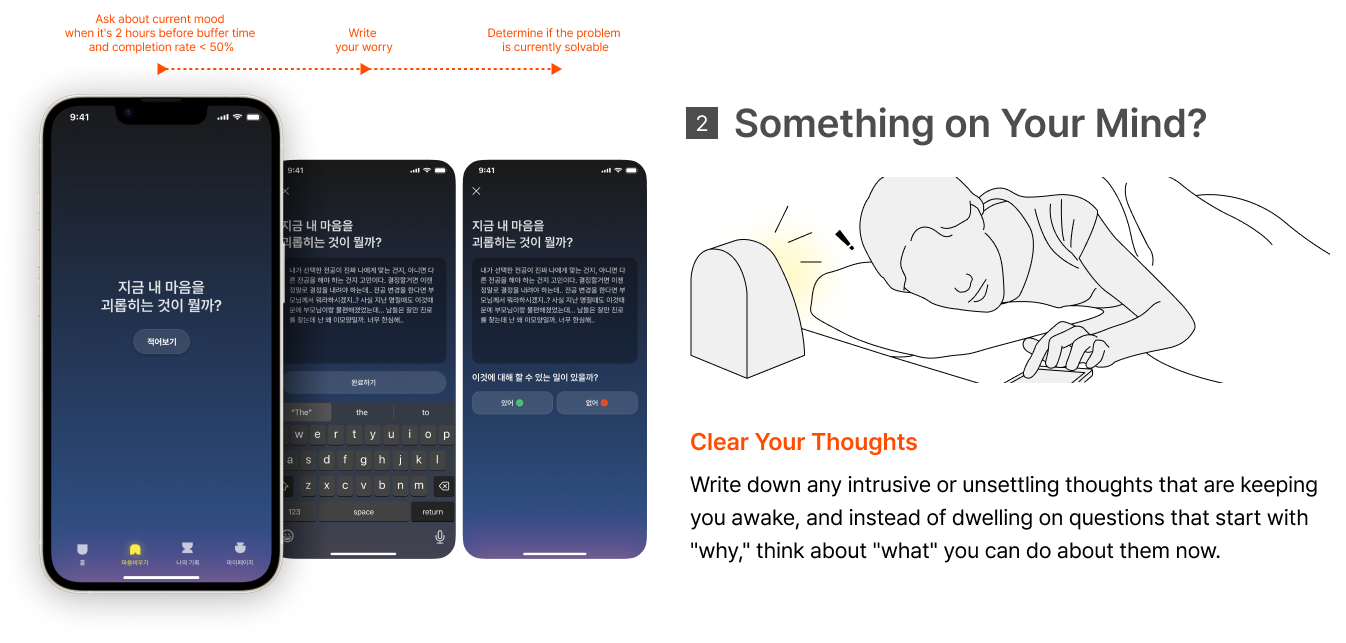
Letting go of worries: Getting thoughts out of one’s head
When their mood is unsettled or they have completed few of their planned activities, the app suggests a worry-release exercise. Writing down worries and tangled thoughts helps users bring rumination out of their heads and ease cognitive arousal before bed.
I built an app prototype in Flutter to demonstrate the core experience.
4-2 Preparing for Sleep Through Light and Sound
The smart light supports environmental cues and sleep hygiene, helping users step away from smartphone stimulation and shift toward their evening routine and bedtime preparation.
-
Gentle cues for changing activities
Instead of relying on direct, potentially burdensome push notifications, the light uses subtle changes in brightness and color, blinking patterns, and sound to prompt a shift in activity.
-
Creating a setting for winding down
Users choose light and sound settings for the final part of their evening, creating space to release tension and focus on rest before bed.
-
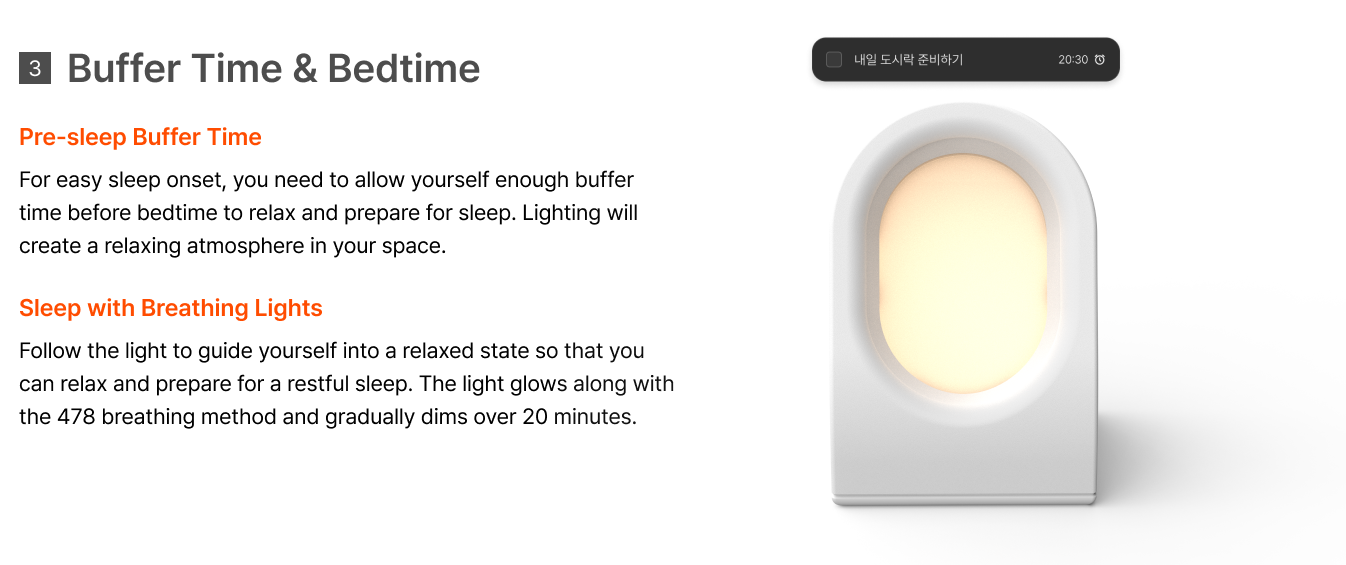
Breathing with the rhythm of light
The light brightens and dims to guide 4-7-8 breathing, linking the rhythm of breathing with changes in light to support physical relaxation and sleep preparation.
The form of the light was inspired by an airplane window, suggesting a journey away from everyday life and toward rest.
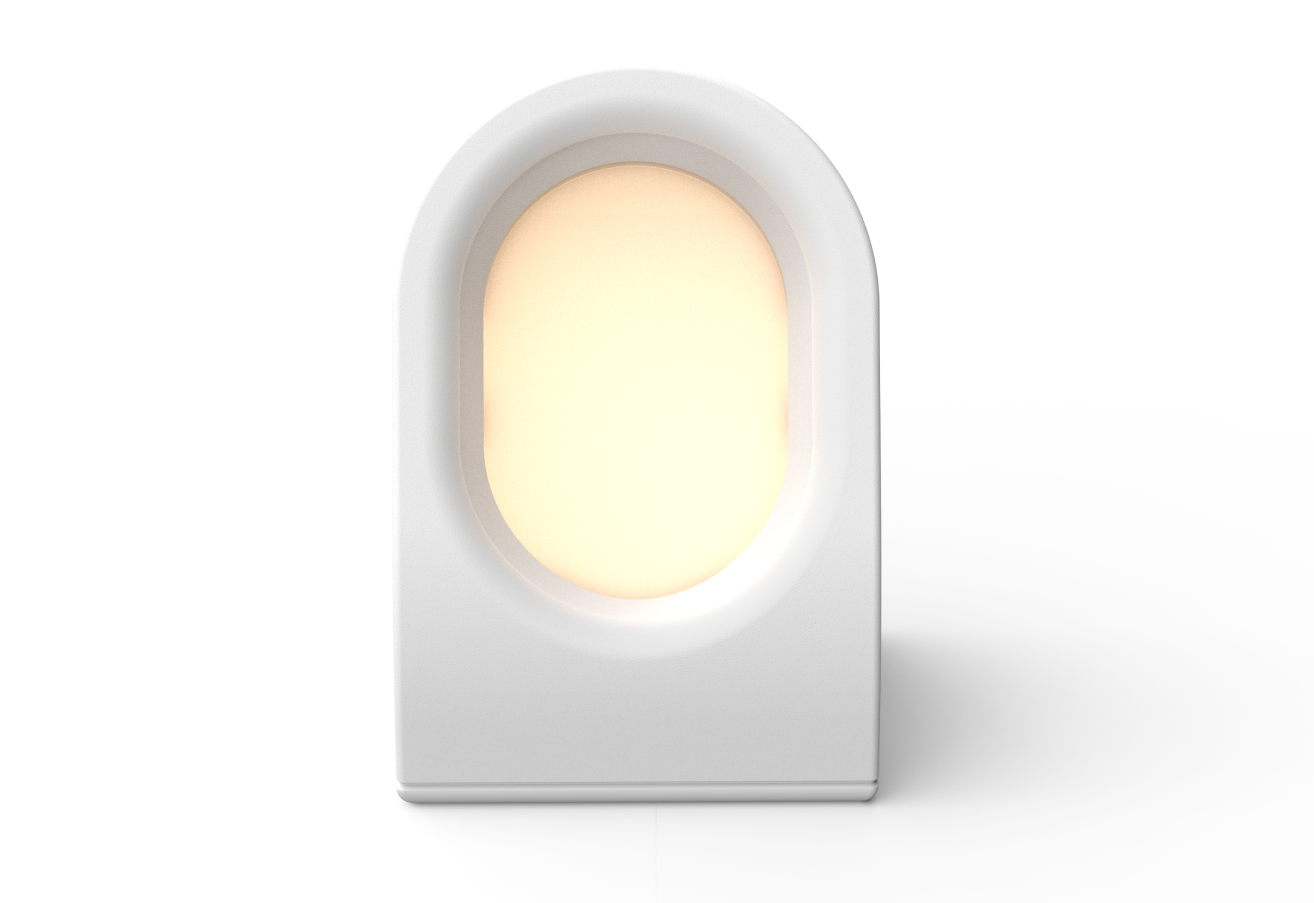
I built a prototype using an Arduino MKR WiFi 1010 and BLE communication. It plays the chosen light and sound settings, changes brightness to guide breathing, and gradually turns off.
4-3 Usage Scenario
-
Beginning the evening: Checking in and choosing a direction
At the start of the evening, users check how they feel and how alert they are, then consider what they need. This helps them find a balance between rest and activity and begin the evening more intentionally.
-
During the evening: Finding a way back from distractions
Fatigue, stress, and unfinished tasks can draw people toward quick bursts of digital stimulation. At these moments, the system offers gentle environmental cues and a chance to let go of worries, helping them return to the kind of evening they need.
-
Before bed: Easing into sleep
Simply deciding it’s time to sleep may not be enough. Buffer time helps users gradually release the day’s tension, while breathing along with the light’s rhythm helps their bodies and minds prepare for sleep.
-
The next day: Looking back and preparing for tomorrow
Users briefly review the previous evening and their sleep, reflecting on how they felt and which activities they followed through on. Over time, this helps them develop an evening routine that better suits them.
5 Reflection
- Following the causes, not the first problem definition: I started with the broad theme of mental healthcare. As the research unfolded, I realized that the more important design opportunity lay in the evening hours leading up to sleep, rather than the moment of falling asleep itself. Existing solutions paid relatively little attention to this part of the day. The project taught me to keep revisiting the problem definition and follow the reasons behind people’s experiences and behavior, rather than holding on to my first framing.
- Focusing on the experiences that matter most: With so many sleep and healthcare products already available, finding a distinct direction was difficult. Instead of designing every possible feature in detail, I concentrated on a few experiences that seemed central to behavior change: checking in at the start of the evening, letting go of worries, making buffer time, and preparing for sleep. I brought these together in an MVP prototype. It reminded me that a new concept doesn’t need a long list of features. Even within a limited scope, its central value should come through clearly.
- Supporting agency rather than control: This project made me think about how direct instructions or strong rewards might become another burden at the end of an already tiring day. I know from my own experience that even a rewarded activity can start to feel overwhelming once it turns into something I have to do. That is why I gravitated toward self-awareness, gentle environmental cues, and gradual transitions: ways to help people move toward a better state on their own terms. Even when the destination is the same, I believe the experience should be shaped around each person’s state, circumstances, and motivation, rather than imposed on them.